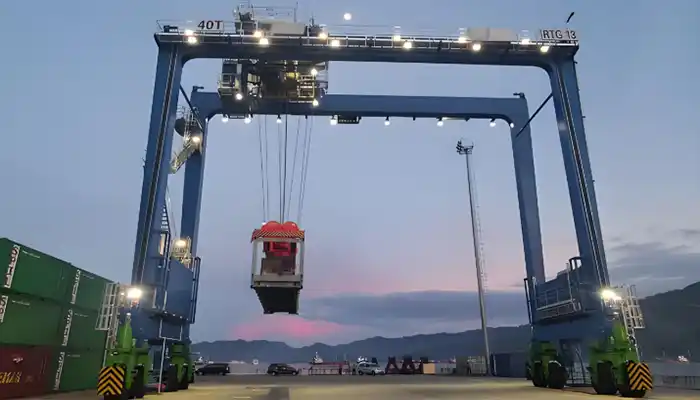
RTG Crane Zero-Turn Solution for Tight Container Yards
menu_open
Content Quick Link
RTG Crane for Tight Yard with Zero Turning Radius
In narrow container or steel yard operations, failure to define turning radius and movement space in advance can lead to serious on-site inefficiency, especially when RTG crane maneuverability does not match real working conditions.
- Eliminates failure of crane positioning in confined yard space
- Solves inability to turn or align containers during stacking
- Improves efficiency in tight port and industrial storage layouts
- Prevents redesign or modification after equipment delivery
- Ensures correct RTG crane selection based on real working path
Questions solved in this case:
- Why can RTG cranes fail to align in narrow container yards?
- How to handle zero turning radius or no space for turning?
- What crane design is needed for extremely tight stacking operations?
- How to avoid wrong crane selection caused by missing site data?
Project Background-Client Industry & Application
Port Container Yard with Tight Layout Conditions
This project comes from a port logistics company that mainly handles container stacking, unloading, and short-distance yard transfer. The daily work is simple on paper, but the site layout is not simple at all. The storage lanes are narrow, and the stacking area is arranged very densely to increase yard capacity.
In this kind of environment, every meter of space matters. Not only for lifting, but also for driving, turning, and positioning the crane.
- Industry: Port logistics and container yard operation
- Main operation: Container loading, unloading, stacking, and transfer
- Working objects: Standard ISO containers (20ft and 40ft)
- Load condition: Around 20–40 tons per lift including spreader and handling system
- Yard layout: Narrow aisles with limited clearance between stacks
- Movement space: Almost no buffer zone for turning or repositioning
In practice, the crane is not just lifting containers vertically. It has to move between lanes, align with stacks, and position containers accurately without blocking other operations. That's where the space issue becomes obvious.
Equipment Selection Was Based on Capacity, Not Movement Space
At the beginning of the project, the buyer focused mainly on lifting capacity and basic RTG parameters. The thinking was quite direct: "If it can lift 40 tons, it should be fine."
But one key point was missed — how the crane actually moves inside the yard.
- Standard RTG specification was selected
- Focus was on lifting capacity and span only
- Turning space and aisle width were not clearly checked
- Real stacking path and movement sequence were not fully mapped
So the equipment design matched the load requirement, but not the working route. This is often where problems start in compact container yards.
When the crane arrived and started trial positioning, it became clear that straight-line movement alone was not enough. The crane needed to adjust direction within very limited space, almost without room to turn.
Lifting Requirements & Operational Challenge
The following sections describe the site constraints and operational difficulties that define the crane handling requirements in this project.
Narrow Yard Layout with Very Limited Clearance
The working lanes in this project are extremely tight. Containers are stacked close to each other, and the clearance between rows is just enough for crane travel. There is almost no extra space reserved for turning or side adjustment.
In daily operation, this means the crane cannot "take a detour" when positioning a container. It has to go straight in, align, and place the load in one controlled movement.
- Stacking lanes are narrow with minimal side clearance
- Distance between container rows is strictly limited
- Crane travel path is fixed and constrained
- No extra buffer area for alignment correction
This kind of layout is usually designed to maximize storage capacity, but it also increases the difficulty of crane maneuvering.
No Space for Normal Turning or Repositioning
One of the key limitations is that there is no practical space for the crane to perform traditional turning movements. In many standard RTG operations, the crane can adjust position by turning or slightly repositioning before final alignment.
Here, that option does not exist.
- No turning radius available in working lanes
- No space for multi-step alignment movements
- Crane cannot stop, rotate, and re-approach freely
- Movement must follow a direct path only
In simple terms, once the crane enters a lane, it has to "commit" to the movement. There is no room for correction through large directional changes.
Requirement for Fast Container Placement
The operation is not occasional lifting. It is continuous container handling with a relatively high turnover rate. After each unloading cycle, the container needs to be placed quickly so the next cycle can continue without delay.
- Continuous loading and unloading flow
- Short cycle time between lifts
- High demand for precise yet fast positioning
- Minimal waiting time between operations
If positioning takes too long, it directly slows down the entire yard workflow. In port operations, this kind of delay tends to accumulate quickly.
High-Frequency Operation Under Continuous Flow
The crane is expected to run in a stable and repetitive cycle throughout the working shift. There is no "idle time" between tasks, especially during peak hours.
- Continuous lifting cycles without long pauses
- Repeated entry and exit from stacking lanes
- Frequent alignment and positioning tasks
- Operator fatigue becomes a factor in accuracy
Under this working rhythm, even small inefficiencies in movement or alignment can create delays across multiple container moves.
Core Operational Challenge
The main issue is not lifting capacity or structural strength. The real challenge is movement behavior inside the confined yard.
The crane must be able to complete positioning in a single smooth motion. If it relies on multiple turning steps or repeated adjustments, the whole stacking process slows down and becomes harder to control.
- Positioning must be completed in one continuous movement
- Multi-step turning is not suitable for this layout
- Any extra alignment step reduces overall stacking speed
- Smooth, direct placement becomes the key requirement
In this type of yard condition, movement efficiency is just as important as lifting performance.
Recommended Crane Solution-Design & Technical Parameters
RTG Crane with Zero-Radius Movement for Confined Yard Operation
For this type of container yard, the equipment cannot rely on standard RTG travel behavior alone. The key point is how the crane behaves when space is too tight to allow normal turning or multi-step repositioning.
A rubber tyred gantry crane (RTG) is still the base structure, but it needs a specific movement design adapted for narrow working lanes. In practice, this means adding a zero-radius maneuvering function so the crane can adjust direction without requiring large turning space.
- Rubber Tyred Gantry Crane (RTG) as the main structure
- Equipped with zero-radius or in-place rotation capability
- Designed specifically for compact yard logistics operations
- Suitable for container stacking in constrained layouts
This type of configuration is not standard off-the-shelf. It is adjusted based on actual yard geometry and movement path.
Custom Design for Confined Yard Logistics
In this project, the crane is not only a lifting device. It also acts as a positioning tool inside a very limited space system. Because of that, the design is focused on controlled movement rather than wide-area travel.
- Customized layout based on real lane width
- Movement path optimized for tight stacking rows
- Reduced dependency on long turning arcs
- Better control during final container placement
The idea is simple: instead of forcing the yard to fit the crane, the crane is adapted to fit the yard.
Key Technical Specifications
The following parameters are defined based on typical 20ft–40ft container handling with spreader systems and continuous operation requirements.
- Lifting capacity: 30–50 tons, adjustable depending on container weight and spreader configuration
- Span: Designed according to actual lane width and stacking block layout
- Travel system: Multi-wheel independent drive system for flexible movement in restricted space
- Turning mode: Zero-radius or in-place rotation, allowing direction change without large clearance
- Control system: Precision positioning with anti-sway control to stabilize container during fast placement
- Power system: Diesel-electric configuration or cable reel hybrid, selected based on yard infrastructure and power availability
Engineering Focus of the Solution
The main purpose of this design is not just lifting performance, but controlled movement inside narrow working corridors. Each technical choice supports one goal: keeping the crane stable while it moves and positions containers in limited space.
- Smooth alignment without multi-step repositioning
- Stable operation during continuous container cycles
- Reduced dependence on wide turning space
- Improved accuracy during fast stacking tasks
This setup allows the crane to operate in a yard where traditional RTG movement would normally struggle due to space restrictions.
Engineering Advantages of the Solution
The following sections explain the key engineering improvements of this RTG configuration designed for narrow and high-density container yards.
In-Place Rotation for Direct Positioning
One of the key improvements in this RTG configuration is the ability to rotate on the spot. In a narrow container yard, the crane does not have enough room to swing or reposition through long movement paths. So the design focuses on controlled in-place adjustment.
This allows the operator to adjust direction and align the spreader directly above the target container position without leaving the working lane.
- 360° in-place rotation for precise alignment
- Direct positioning without multi-step turning
- Better control during final landing of containers
- Reduced dependence on open yard space
In daily operation, this makes container placement more straightforward, especially when working between tightly packed rows.
No Need for Large Turning Corridors
Traditional RTG layouts often assume there is enough space for turning or side repositioning. That assumption does not hold in compact yards. This solution removes that requirement completely.
Instead of designing around turning radius, the system is built around linear movement with localized rotation.
- Eliminates requirement for wide turning space
- Works within fixed narrow lanes
- Reduces dependency on yard redesign
- Suitable for high-density storage layouts
This is particularly useful in older ports or upgraded yards where space cannot be expanded.
Faster Stacking in Narrow Aisles
When movement is simplified, stacking speed improves naturally. The crane does not need to pause for alignment corrections or repeated repositioning. It moves, adjusts, and places the container in one flow.
- Faster cycle time per container
- Less waiting time between positioning steps
- Smoother workflow in continuous operation
- Improved productivity in high-frequency tasks
In practical operation, this reduces small delays that often add up during peak working hours.
Lower Collision Risk in Tight Working Areas
In congested container yards, collision risk usually comes from excessive movement or repeated turning attempts. By limiting unnecessary motion, the crane becomes more predictable and easier to control.
- Fewer complex turning movements
- Stable travel path in narrow lanes
- Reduced operator correction actions
- Safer operation near stacked containers
This is especially important when multiple cranes or transport vehicles are working in the same area.
Adaptability to Irregular Yard Layouts
Not all container yards are perfectly structured. Some have uneven spacing, partial expansions, or mixed stacking zones. This design can adjust to those variations without requiring major structural changes.
- Works in irregular lane arrangements
- Suitable for phased yard expansion
- Flexible response to layout constraints
- Compatible with mixed storage patterns
It gives operators more tolerance when working with non-standard site conditions.
Continuous Operation in Fully Constrained Yards
This configuration allows the crane to operate in conditions where traditional RTG movement would be restricted. Even when there is no clear turning space, no buffer zone, or tightly packed stacking rows, the system still maintains controlled positioning and stable operation.
It is designed for one practical goal: keeping container handling continuous and manageable even in fully space-constrained yards.
Problems Solved
The following Q&A sections explain the real operational issues encountered on site and how they are addressed through improved crane movement design.
Q1: Why did the RTG crane fail to align containers on site?
A: The main reason was not the lifting capacity, but the lack of available turning space combined with a crane design that did not support in-place rotation.
In this project, the yard lanes were too narrow for normal adjustment movements. Once the crane entered a stacking row, it had very limited room to correct its direction.
- No sufficient space for turning or side repositioning
- Standard RTG movement model assumed wider working lanes
- Container alignment required multiple small adjustments
- Final positioning became slow and unstable in practice
So the misalignment problem was directly linked to the mismatch between site layout and crane movement design.
Q2: Can a standard RTG work in very narrow container yards?
A: It can operate, but not in a stable or efficient way when the space is extremely limited.
Standard RTG cranes are usually designed for yards with defined turning corridors and clearer movement paths. When these conditions are missing, performance drops quickly.
- Requires basic turning radius for repositioning
- Depends on wider aisle spacing for alignment
- Slower operation in tight stacking blocks
- Higher operator correction during placement
In very narrow yards, the equipment becomes harder to control during continuous stacking cycles.
Q3: What is the key requirement for tight yard crane design?
A: The most important requirement is controlled movement without relying on large turning space.
In compact container yards, the crane must be able to adjust position and orientation within the same working line. This avoids repeated forward–backward adjustments.
- In-place rotation capability for direction change
- Micro-positioning during final container alignment
- Stable travel in narrow lanes without detours
- Reduced dependency on turning corridors
This type of movement control is more important than increasing lifting capacity.
Q4: How can buyers avoid similar installation problems?
A: The key is to provide complete and realistic site information before the crane design is finalized.
Many issues appear after delivery because the actual working space was not fully considered during the early planning stage.
- Share full yard layout and lane dimensions
- Define real container stacking flow and movement path
- Clarify turning space availability (or lack of it)
- Involve site measurement when conditions are complex
When the working environment is clearly defined, the crane design can be matched properly, and on-site adjustment problems are greatly reduced.
Engineering Insight for Crane Buyers
These points highlight the practical engineering considerations that are often overlooked during early crane selection and project planning.
Movement Space Matters More Than Lifting Capacity
For many port, steel yard, or logistics projects, buyers often focus first on tonnage. How many tons it can lift, what span it has, whether it meets the basic load requirement. These are important, but in practice they are not the part that causes trouble on site.
What usually gets missed is the real movement condition of the crane. Not just how much it lifts, but how it moves, turns, and aligns inside the working yard.
- Actual aisle width and clearance between stacks
- Whether turning or repositioning space is available
- Container flow direction during daily operation
- Entry and exit path for each stacking cycle
If these details are unclear, even a properly rated crane may struggle once it arrives on site.
Small Layout Details Decide Real Operation Performance
In tight container yards or steel storage areas, a few meters can change the whole operation behavior. A crane that works smoothly in an open layout may become difficult to control when the lanes are compressed.
- Turning path not defined clearly during design stage
- Stacking direction not matched with crane travel route
- Lane width slightly reduced due to storage optimization
- No buffer zone left for alignment correction
These are not major design mistakes, but they directly affect how the crane behaves during daily operation.
Design Stage Communication Is Often Incomplete
In many cases, the early technical discussion focuses on specifications, not working flow. The result is that the crane is designed based on numbers, but not based on actual movement logic.
- Capacity and span are confirmed early
- Site movement flow is not described in detail
- Turning radius is assumed, not measured
- Real stacking sequence is not provided
This gap between "design data" and "real operation" is where most installation problems start.
Practical Understanding for Buyers
Before finalizing a crane solution, it is not enough to confirm only technical parameters. The working environment should be described in a way that reflects how the crane will actually move day by day.
- How containers enter and leave the yard
- Whether the crane moves in straight lanes or cross lanes
- If repositioning is needed during stacking
- How tight the final placement area really is
When this information is clear, the crane design can match the working behavior instead of only matching the load requirement.
Conclusion
This case highlights a key principle in RTG crane selection: space defines performance more than lifting capacity. In tight container yards, zero-turn or in-place rotation capability becomes essential to ensure safe, continuous, and efficient stacking operations. Early-stage communication and on-site measurement are critical to avoid costly redesign and operational delays.

Article by Bella ,who has been in the hoist and crane field since 2016. Bella provides overhead crane & gantry crane consultation services for clients who need a customized overhead travelling crane solution.Contact her to get free consultation.